 Gnuke
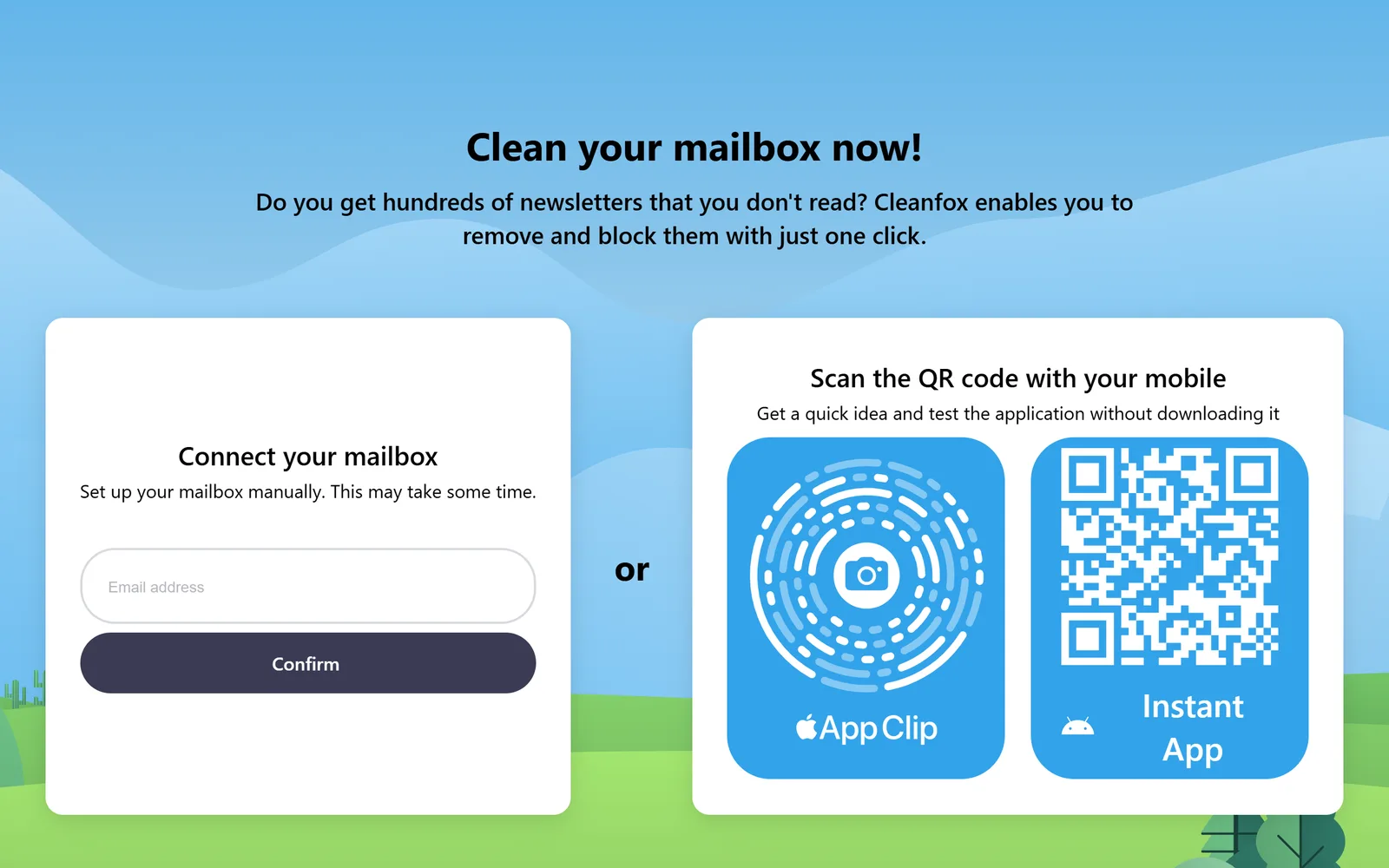
 Cleanfox is free, works with almost every mail provider and has more than 10 million
 Android downloads. The price is in its own policy: it copies the commercial emails in your inbox, and says it may sell data about them.
 Gnuke covers
 Gmail only, charges after 10 free nukes, and keeps every email on your own device.
The short version#
Both tools get you out of newsletters and clear old mail to Trash. Cleanfox does it with a swipe on your phone, for any mailbox, and pays for itself by selling data built from your commercial email. Gnuke does it in one click on a sender in Gmail, with Undo for 30 days, and you pay if you go past 10 nukes. Neither one is a one-time cleanup: Cleanfox keeps future mail from senders you delete in Trash, and Gnuke's Block and scheduled auto cleanup do the same for Gmail.
Side by side#
| Gnuke | Cleanfox | |
|---|---|---|
| Price | GnukeFirst 10 nukes free, every feature but auto cleanup. Unlimited is $29.99 a year or $4.99 a month, for up to 3 Gmail accounts | CleanfoxFree, "no subscriptions, no trial periods, and no hidden fees" (FAQ). Paid for with data, see below |
| Platforms | GnukeChrome extension for Gmail on a computer, plus a phone app | CleanfoxiOS app (4.8 stars, 27K ratings, App Store), Android app (4.7 stars, 337K reviews, 10M+ downloads, Google Play) and cleanfox.io in a browser. No Chrome extension (Chrome Web Store search) |
| Mail providers | GnukeGmail | CleanfoxGmail, Outlook, Yahoo, Hotmail, iCloud, AOL, Exchange and IMAP accounts, unlimited accounts (Google Play). Business domains are excluded (terms) |
| How it connects | GnukeYour browser or phone talks to Gmail directly | CleanfoxCleanfox's servers read your mailbox over IMAP. For Gmail you turn on IMAP and 2-step verification and create an app password (FAQ) |
| Unsubscribing | GnukeOne-click request when the sender supports it, otherwise an unsubscribe email from your address, otherwise opens the sender's page. Result reported per sender | CleanfoxDeletes instead: "we have decided to opt for the automatic deletion of your unwanted newsletters" (FAQ) |
| Mail you already have | GnukeEvery email a sender ever sent goes to Trash in the same click. Clean up ranks senders and shows the storage each takes | CleanfoxPer sender, delete the emails already received, with or without deleting future ones (FAQ) |
| New mail | GnukeBlock sends a sender's future mail to Trash with a Gmail filter. Auto cleanup (Unlimited) clears old newsletters and promos on a schedule | CleanfoxFuture mail from a sender you delete goes to Trash automatically (FAQ) |
| Undo | Gnuke30 days, nothing deleted permanently. Starred mail always stays | CleanfoxMail goes to Trash, never permanently deleted, and an in-app list lets you reverse a choice (FAQ). No starred-mail protection described |
| Where your mail is processed | GnukeIn your browser or on your phone. No Gnuke server sees your mail | CleanfoxOn Cleanfox's servers, which its FAQ says are in Germany. It collects copies of your commercial emails (privacy notice) |
| Data practices | GnukeNo analytics, ads or tracking in the extension or phone app. Nothing sold | CleanfoxData from commercial emails goes into a consumer panel and may be sold or shared with customers, data brokers included (privacy notice). Opt-out in the app |
| Owner | GnukeGnuke itself, paid for only by Unlimited plans. No ads, nothing sold | CleanfoxNielsenIQ, which bought Foxintelligence in 2021 (Research Live) |
We checked this table on October 23, 2026, against Cleanfox's home page, FAQ, terms, privacy notice, cookie notice and health data notice, plus its  App Store and
 Google Play listings. Plans and features change.
The real differences#
Is Cleanfox safe? What its own pages say about your data#
Cleanfox says four different things about data, and they fit together only if you read "personal data" narrowly:
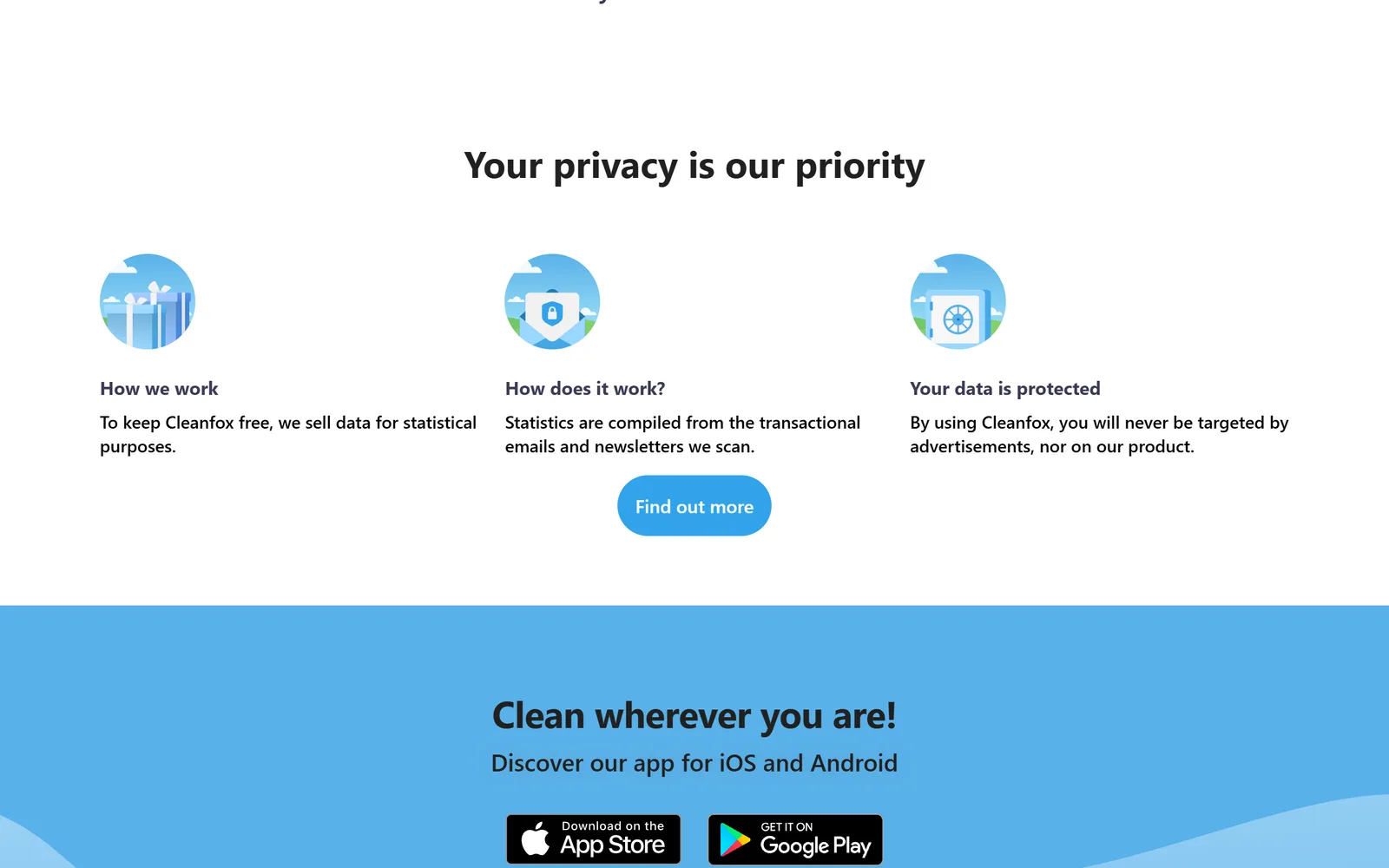
- Its home page says: "To keep Cleanfox free, we sell data for statistical purposes."
- Its FAQ says: "Cleanfox does not sell your personal data. The data used for analysis is anonymized, aggregated, and compliant with the GDPR." It also says: "We provide some of our customers with data about individual transactions based on our processing of users' commercial emails. We work with our parent company,
 NielsenIQ, to remove information that can be directly linked to you."
- Its terms call the arrangement a trade: the user gets the cleaning service free, and "The right for NielsenIQ to extract the data listed in the transactional emails received by the user to market data for statistical purposes."
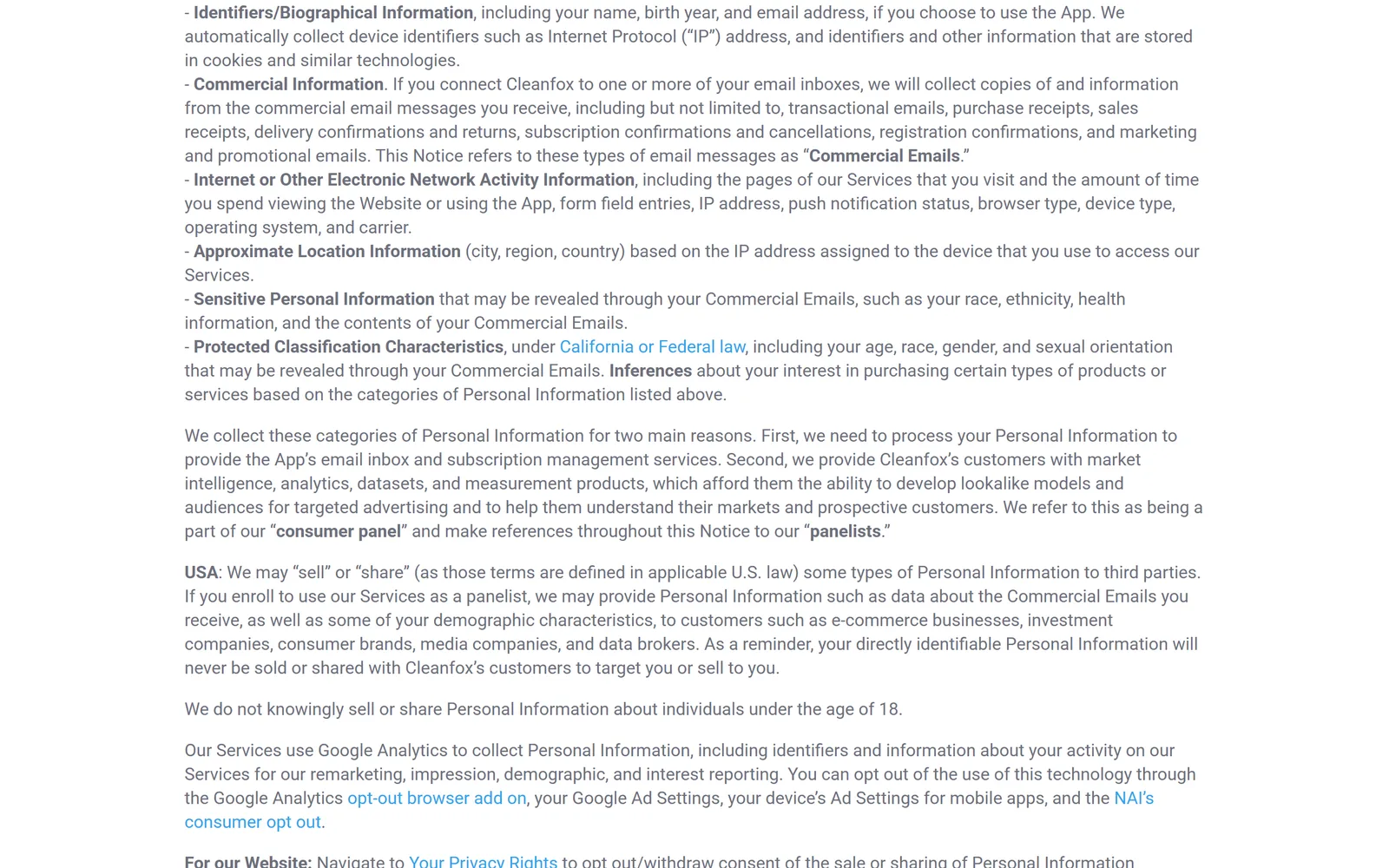
- Its privacy notice, effective July 15, 2025, is the most detailed. For U.S. users it says: "We may 'sell' or 'share' (as those terms are defined in applicable U.S. law) some types of Personal Information to third parties." If you enroll as a panelist, it may provide "data about the Commercial Emails you receive, as well as some of your demographic characteristics, to customers such as e-commerce businesses, investment companies, consumer brands, media companies, and data brokers."
What it collects is broader than a list of newsletters. The notice says that if you connect an inbox, "we will collect copies of and information from the commercial email messages you receive," including purchase receipts, delivery confirmations, subscription confirmations and marketing mail. It lists "Sensitive Personal Information that may be revealed through your Commercial Emails, such as your race, ethnicity, health information, and the contents of your Commercial Emails." A separate health data notice adds that it does not exchange consumer health data with third parties for money. Copies of those emails are kept until you opt out of the panel, delete your account or ask it to stop, and deidentified versions "may be stored indefinitely."
To be fair to Cleanfox, it draws lines too:
- It says it excludes personal email and finds receipts with pattern matching on known sender addresses (FAQ).
- It says it never uses your name, address or directly identifiable details to market to you, and that you are removed from the lookalike audiences it builds for customers' advertising.
- For Gmail data, it says it will not use it for advertising and will not let people read it without your agreement, for security, for legal reasons or for internal operations after aggregating and anonymizing it (privacy notice). Its terms add that "a limited part of our teams may access your transactional emails" to improve its filtering tools.
- You can opt out of the panel in the app, under My Settings, Your Mailboxes, your address, then the NielsenIQ panel. Deleting the mailbox deletes your account and its data (FAQ). The opt-out is in settings, so you reach it after you've connected.
- Cleanfox's pages we checked don't say whether the free service continues after you opt out of the panel.
One more line in the notice affects Gmail users. It says Google's restriction on how third parties use Gmail API data "will not apply to other Gmail users that sign up for our Services by providing us with a Google App Password." The FAQ walks Gmail users through creating an app password.
The store listings point the same way. The App Store label says identifiers may be used to track you across other companies' apps and websites, and lists emails or text messages, browsing history and sensitive info as data linked to you. Google Play lists emails, purchase history and approximate location as collected, with device IDs and app interactions shared.
Gnuke reads message metadata (sender, subject, unsubscribe headers, read or unread) in your own browser or phone. It opens a message body only when it needs an unsubscribe link the headers don't carry. Nothing about your senders or what you nuke leaves your device. See the privacy policy.
Who owns Cleanfox#
Cleanfox was built by Foxintelligence, a French e-commerce measurement company. NielsenIQ announced its acquisition on December 10, 2021 and said Foxintelligence had about 600,000 consumer panel participants across five European countries. Cleanfox's FAQ explains the reason: "NielsenIQ acquired Foxintelligence to enrich its data panel and offer e-commerce insights to its professional clients." Today the site footer reads "© 2026 NielsenIQ," the Android listing names NielsenIQ as the developer, and the privacy notice says Cleanfox is "a NielsenIQ company." NIQ Global Intelligence, the public company behind NielsenIQ, listed on the NYSE in July 2025 and is majority owned by Advent International.
Cleanfox has been asked about this before. In February 2020, Motherboard reported that Foxintelligence sold products built from Cleanfox users' emails, with a client list in its presentation that included PayPal, Bain & Company and McKinsey & Company. Cleanfox replied that the claims were "false and defamatory" and that it has "never sold and will never sell personal data to third-parties" (9to5Mac). Foxintelligence's COO said at the time that not all the brands on the slide were clients.
What each one does to a sender#
Cleanfox gives you three choices per sender: keep, delete the old emails and stay subscribed, or delete the old emails and automatically trash future ones (FAQ). The Google Play listing calls the left swipe "unsubscribe," but the FAQ says it deletes rather than unsubscribes, because unsubscribing from some newsletters would need your email address and password. The sender still has you on the list and mails you, and Cleanfox keeps moving it.
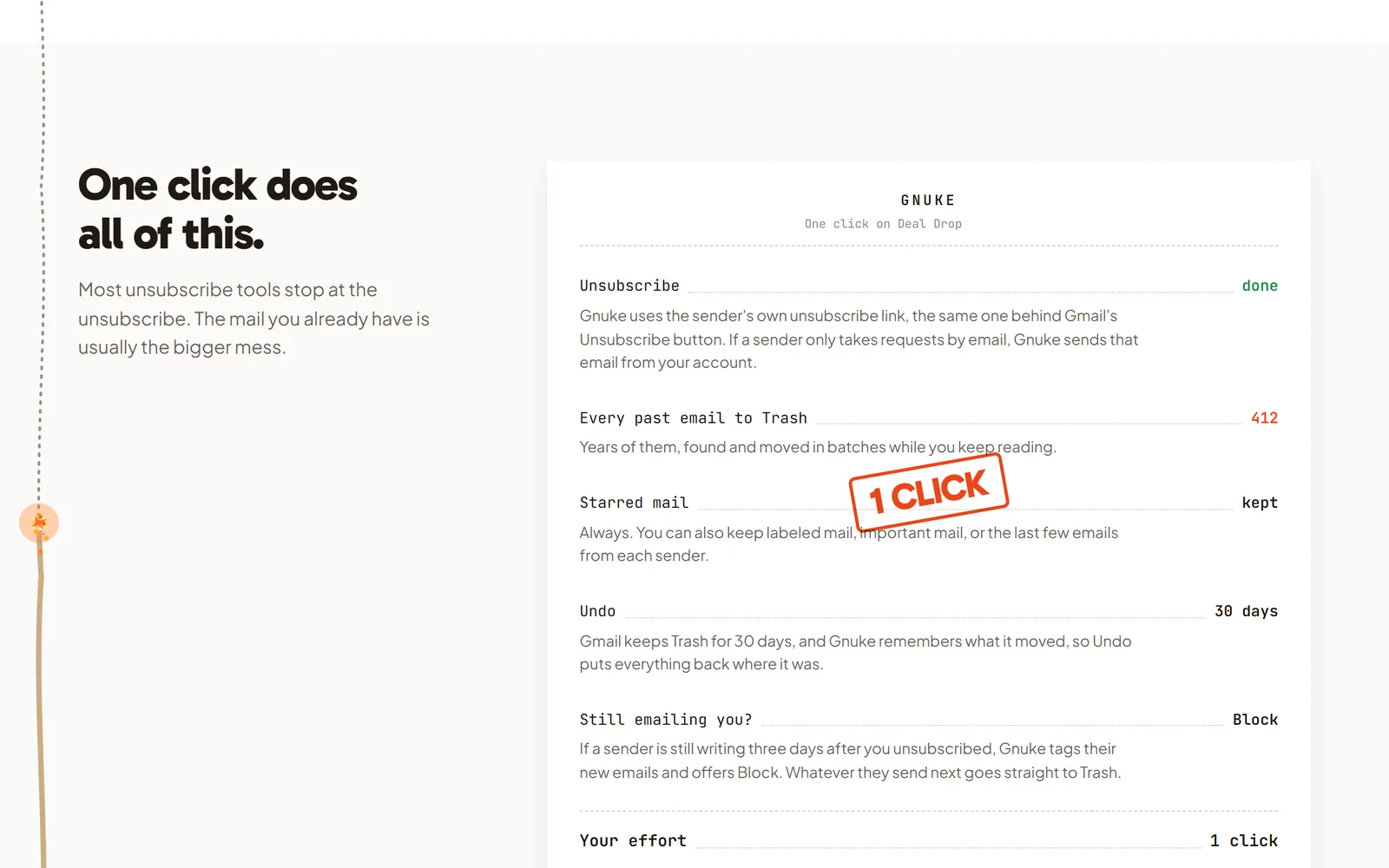
Gnuke does the sender-side work too. It sends the unsubscribe request the best way the sender allows, moves everything they ever sent to Trash, and Block files future mail into Trash with a Gmail filter. On Unlimited, auto cleanup also clears old newsletters and promos on a schedule you set.
Undo and what stays#
Cleanfox never deletes permanently. Mail goes to your Trash, and its FAQ says Gmail empties Trash after 30 days. The app also keeps a list of what you deleted or blocked so you can reverse a choice. It describes no way to protect starred, labeled or important mail, or to keep a sender's newest few.
Gnuke records what it moved, and Undo puts it all back for 30 days. Starred mail always stays, and you can also keep labeled mail, important mail, or a sender's newest 1, 3 or 10 emails. Senders you "always keep" are never offered for nuking.
Extras that Gnuke adds#
Clean up scans your newsletters and promos and ranks senders by how many emails they sent and how often you open them, with labels like "Never opened" and "Quiet for 6+ months." You can tick several and nuke them together. "Still emailing you" flags senders who keep mailing more than 3 days after you unsubscribed, with a one-click Block. You can also nuke a whole domain (not for shared providers like gmail.com). New mail checks tell you when 25 or more new emails are worth nuking or a nuked sender is back.
Where Cleanfox is better#
- It is free with no limit. Gnuke's first 10 nukes are free, then Unlimited costs $29.99 a year or $4.99 a month.
- It works with Gmail,
 Outlook,
 Yahoo, Hotmail,
 iCloud,
 AOL, Exchange and any IMAP account, and handles unlimited accounts. Gnuke works with Gmail only.
- It has native iOS and Android apps, rated 4.8 on the App Store and 4.7 on Google Play, with more than 10 million Android downloads. Gnuke's phone version is a web app you add to your Home Screen.
- Its swipe design is built for a phone, and the app comes in 22 languages (App Store).
- Users like it: 4.9 stars from 8,925 reviews on Trustpilot.
- It states how it pays for itself on its home page, in its terms and in its notice, and it gives you a way to opt out and to delete everything.
Who should pick which#
Pick Cleanfox if your mail isn't on Gmail, if you want a free app with no limits, and if you're comfortable with a NielsenIQ panel that reads copies of your commercial email. If you use it, switch off the panel in settings right after you connect.
Pick Gnuke if your mail is on Gmail and you want it handled without a company copying it, Undo for 30 days, your starred mail left alone, keep rules, a Clean up view for ranking senders, and an unsubscribe that goes to the sender. See how it works, pricing and what stays on your device under privacy before you install.
Weighing other tools? See Gnuke vs  Trimbox, Gnuke vs
 SaneBox, Gnuke vs
 Clean Email, Gnuke vs
 Unroll.me and Gnuke vs Gmail's Manage subscriptions. To learn the manual route first, read how to delete all emails from one sender in Gmail, how to unsubscribe in bulk or how to block an email address in Gmail.
Sources#
- Cleanfox home page
- Cleanfox FAQ
- Cleanfox terms
- Cleanfox privacy notice, effective July 15, 2025
- Cleanfox consumer health data privacy notice, April 21, 2025
- Cleanfox cookie notice
- Cleanfox on the App Store (ratings and App Privacy)
- Cleanfox on Google Play and its Data safety section
 Chrome Web Store search for Cleanfox, no results on October 23, 2026
- Cleanfox on Trustpilot
- NielsenIQ acquires Foxintelligence, Research Live, December 10, 2021
- NIQ completes its initial public offering, Simpson Thacher, July 24, 2025
- Motherboard, February 10, 2020
- 9to5Mac on the Motherboard report and Cleanfox's reply, February 2020
Frequently asked questions
Is Cleanfox safe?
It is a real product from a large company, with 10M+ Android downloads, and it says it only moves mail to Trash and never deletes it for good. The cost is data. Its privacy notice says it collects copies of the commercial emails in your inbox and that in the U.S. it may sell or share data about them, with demographics, to e-commerce businesses, investment companies, consumer brands, media companies and data brokers. Its FAQ says it ignores personal email and never uses the data for advertising, and the app has an opt-out. Gnuke has no server that sees your mail, so there is nothing to sell.
Is Cleanfox really free, and how does it make money?
Yes, free with no limits, subscriptions or trial. Its home page says "To keep Cleanfox free, we sell data for statistical purposes," and its terms call the data the price of the service. Gnuke's first 10 nukes are free, and Unlimited is $29.99 a year or $4.99 a month for up to 3 Gmail accounts.
Does Cleanfox sell your data?
Its wording depends on the page. The home page says it sells data for statistical purposes. The FAQ says "Cleanfox does not sell your personal data" because what it uses is anonymized and aggregated. The privacy notice says that under U.S. law it may "sell" or "share" data about the commercial emails you receive, plus demographics, to customers including data brokers, while directly identifiable details are never sold. You can opt out of the panel in the app. Gnuke sells nothing and has no analytics in the extension or phone app.
Who owns Cleanfox?
NielsenIQ. Cleanfox was built by the French company Foxintelligence, which NielsenIQ acquired in December 2021. Its site footer reads "© 2026 NielsenIQ," and its Android listing names NielsenIQ as the developer. NIQ Global Intelligence, the public company behind NielsenIQ, has been listed on the NYSE since July 2025 and is majority owned by Advent International.
Does Cleanfox have a Chrome extension or work with Gmail?
It works with Gmail, but there is no Cleanfox extension in the Chrome Web Store. You use its iOS or Android app, or cleanfox.io in a browser. For Gmail it connects over IMAP with an app password, which means turning on IMAP and 2-step verification first. Gnuke is a Chrome extension for Gmail, plus a phone app you add to your Home Screen.
Does Cleanfox unsubscribe you, or just delete mail?
Mostly it deletes. Its FAQ says that unsubscribing from some newsletters would need your email address and password, so it chose to automatically move unwanted newsletters to Trash instead. You stay on the sender's list. Gnuke sends the unsubscribe request, trashes the sender's whole history, and Block catches anything that still arrives.